 Home
Home Speech Delay vs Autism: Comparing Development Patterns and Key Differences by Age
👶 Is My Child Just a Late Talker, or Is It Something More?
Hearing a child’s first words is a moment every parent anxiously waits for. So when those words don’t arrive on time, it’s completely natural to feel worried.
“Is my child merely a late talker?” “Or could this be an early sign of autism?”
At first glance, speech delays and early signs of autism may look similar. But beneath the surface, their developmental paths can be quite different.
Speech delay is common in early childhood and often just means a child needs more time or targeted support to catch up. But when speech delay comes alongside certain behavioral and social differences, it may point to something more complex like Autism. Understanding these distinctions is key to getting your child the right help at the right time.
In this article, we’ll unpack the differences between speech delay and autism, look at how they appear at various developmental stages, and share key insights from current research so you can feel more confident in navigating your child’s development.
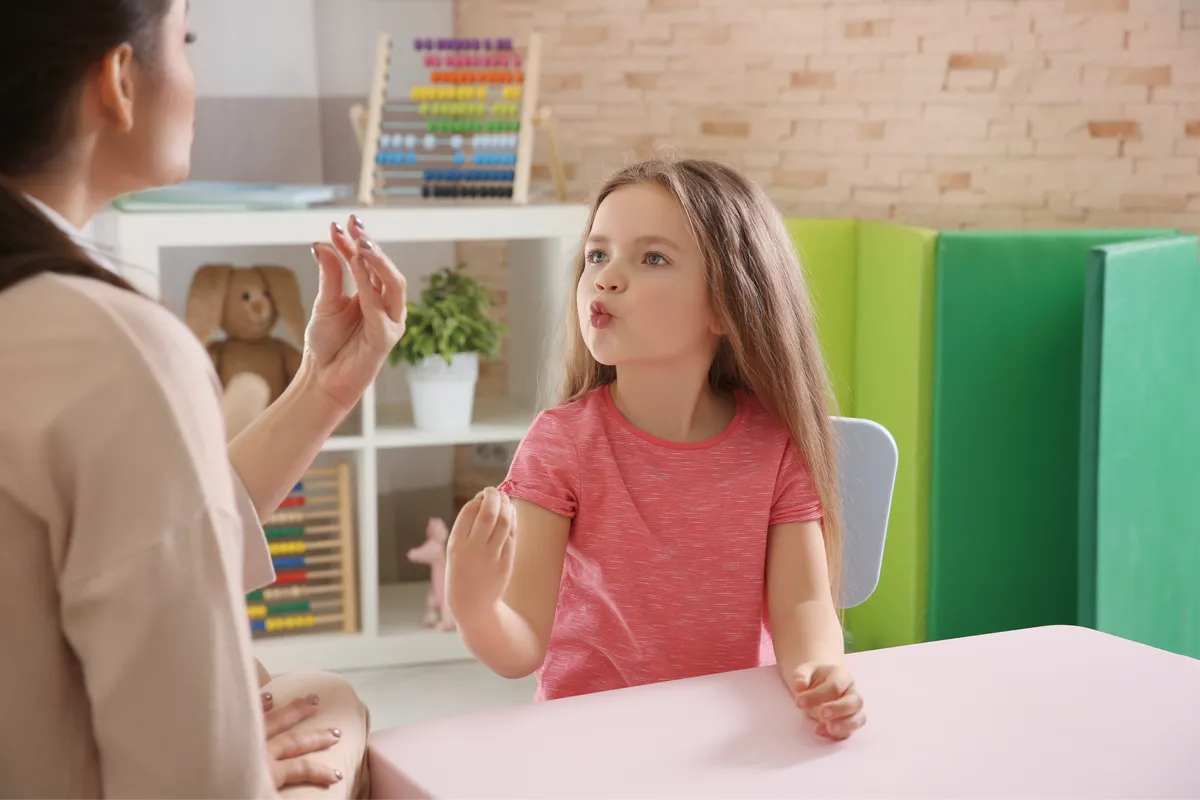
What Is Speech Delay?
- Children with speech delays may begin talking later than their peers or have a more limited vocabulary.
- They might struggle with pronunciation, sentence formation, or grammar.
- Despite these language challenges, they often show a clear desire to connect with others.
- Their cognitive skills and social awareness typically fall within the expected range for their age.
📌 Key Takeaway
In the majority of cases, other areas of development are normal, and the child is actively trying to communicate through nonverbal methods.
What is Autism?
- Autism is a neurodevelopmental disorder that impacts social interactions, communication, and behavior.
- Key features involve challenges in social interaction, restricted communication skills, and repetitive behavior patterns, as well as an enhanced sensitivity towards sensory stimuli.
- Whereas delayed language development is usually seen in children with autism, in contrast, children with autism usually find it difficult to establish meaningful relationships with other individuals.
📌 Key Takeaway
Speech delays can occur in both speech-delayed children and those with autism but autism is marked by a combination of social communication difficulties and repetitive or sensory behaviors, not just a delay in speaking.
Development Comparison Table: speech delay vs autism characteristics
| Age | Stage of Development | Typical Speech Delay | Autism Traits |
|---|---|---|---|
| By 12 Months | Single-word stage - Babbles strings of sounds (e.g., mamama) - Points and waves - Imitates sounds - Says 1 to 2 words (e.g., dada) | - Delayed initiation of first words - Responds to sound - Shows interest in speaking | - Does not respond when called - Avoids eye contact |
| By 18 Months | Two-word phrase stage - Follows simple, 1-step directions - Shakes head for “yes” and “no” - Understands names of common objects and body parts - Uses babbling or jargon with real words | - Limited vocabulary - Struggles with simple phrases - Uses gestures for communication | - Doesn’t use gestures like pointing or pulling adults - Shows little interest in interacting socially |
| By 24 Months | Sentence formation stage - Uses words to ask for help - Combines 2 words to form phrases - Uses and understands at least 50 different words | - May not form two-word phrases - Tries to mimic language | - Uses repetitive behaviors in place of speech - Difficulty with both understanding and expressing language |
| 2 to 3 Years | Grammar development stage - Understands spatial terms (e.g., above, between) - Says their name - Asks “why” and “how” questions - Answers “what” questions - Uses 2 to 3 word phrases | - Can use short sentences, but lacks variety - Can express basic needs | - Repeats phrases out of context - Tends to speak in a monologue rather than having interactive conversations |
| 3 to 4 Years | Complex sentence stage - Tells a story from a book or video - Uses location words like “inside” and “under” - Recognizes signs and logos | - Might struggle to narrate stories or articulate ideas - May have trouble grasping abstract concepts | - Shows little interest in pretend play - Often fixated on specific routines or topics |
You are not alone in this
At Dubu, we’re building a community of parents who’ve faced the same questions, doubts, and hopes. Whether your child is a late talker or navigating early signs of autism, your voice matters and it could help another family feel less alone.
👉 Join the Dubu newsletter for parent-to-parent insights
Speech delay vs Autism Summary of Key Differences
| Category | Speech Delay | Autism |
|---|---|---|
| Eye Contact | Usually proper | Quite limited, if any, or avoids eye contact |
| Social Interaction | Has fun playing with others and interacts socially | Prefers being alone and doesn’t interact much with others |
| Intent to Communicate | Shows clear attempts to speak or express needs verbally | Shows little to no interest in using language to communicate |
| Characteristic Traits | No unusual, repetitive behaviors | Displays repetitive behaviors; attaches readily to routine |
| Sensory Sensitivity | Generally in the typical range | Usually too sensitive to light, sound, textures, or other sensory input |
How Do the Two Conditions Differ?
While both can affect language, speech-delayed children are generally socially engaged. They respond to others, enjoy interaction, and use nonverbal cues like pointing, eye contact, or gestures even if words come late.
In contrast, children with autism may seem more withdrawn. They might avoid eye contact, not respond to their name, or show little interest in social play. Repetitive behaviors like hand-flapping or spinning, as well as echolalia (repeating words or phrases out of context), are more commonly observed in autism.
📌 Key Takeaway
Intentionality matters: speech-delayed children often try to communicate, even without words. Children with autism may not show the same intent or interest in social connection.
What Kind of Help Might My Child Need?
- If your child is socially responsive but has limited speech, they may simply be a late talker. Speech therapy or language-rich activities at home can be highly effective.
- If your child shows reduced eye contact, limited social interaction, and a delay in speech, a professional evaluation for autism is recommended.

Can Speech Therapy Help in Both Cases?
Yes. Speech therapy plays an important role in both speech delay and autism support.
- For speech delays, therapy focuses on building sound production, vocabulary, and sentence formation.
- For autism, speech therapy may address social communication, helping the child learn to initiate interactions, take turns, and understand conversational norms.
The goal isn’t just more speech—it’s more connection. Helping a child communicate effectively with the world is what truly matters.
💌 Got a Story to Share?
At Dubu, we support families navigating speech delays and autism through parent-centered newsletters and AI-powered tools for language development.
We also interview parents who’ve been on this journey, offering real-life insights and encouragement to others.
Your experience could be the guidance and reassurance another parent is looking for.
👉 Join the Dubu newsletter for parent-to-parent insights
📚 Reference
- Kaplan HI, Sadock BJ (1998). Syniopsis of Psychiatry, 8th edition. Williams & Wilkins. pp 33
- Leanne Sherred (2025). Speech Delay vs Autism: What’s the Difference?. Autism Parenting Magazine. https://www.autismparentingmagazine.com/speech-delay-vs-autism/